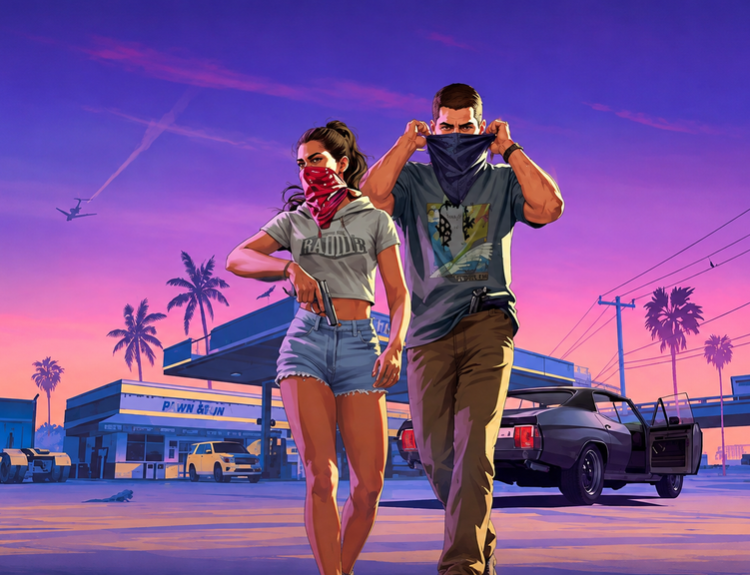

Rockstar Games is set to revolutionize the Grand Theft Auto experience with a groundbreaking change to how non-player characters react to armed players. For decades, GTA protagonists have been able to stroll through bustling city streets while carrying everything from handguns to rocket launchers without raising so much as an eyebrow from the virtual pedestrians around them. That era of blissful ignorance is coming to an end with Grand Theft Auto 6, where NPCs will demonstrate a significantly heightened awareness of potential threats in their environment.
According to an exclusive preview published by The New York Times, players in GTA 6 will no longer be able to casually brandish heavy weaponry without consequences. The report specifically notes that “a player in this one cannot whip out a shotgun or a rocket launcher and walk down the street without expecting the non-player characters to call the police.” This fundamental shift in NPC behavior represents one of the most significant gameplay changes in the franchise’s history, forcing players to think more strategically about when and where they display their arsenal.
A New Era of NPC Intelligence and Realism
The evolution of NPC behavior in Grand Theft Auto games has been a gradual process spanning over two decades. In the original top-down GTA titles from the late 1990s, pedestrians were little more than moving obstacles with minimal artificial intelligence. The transition to 3D with GTA III in 2001 brought more reactive NPCs, but their awareness remained limited. Even in Grand Theft Auto V, released in 2013, players could openly carry military-grade weapons through downtown Los Santos without triggering any response from civilians or law enforcement unless they actually committed a violent act. The decision to make GTA 6’s NPCs more perceptive reflects Rockstar’s commitment to creating a more immersive and believable open world.
This change also aligns with broader trends in open-world game design, where developers are increasingly focused on creating dynamic, reactive environments that respond to player behavior in nuanced ways. Games like Red Dead Redemption 2, also developed by Rockstar, pioneered many of these systems with NPCs that could remember player interactions and respond to threats in contextually appropriate ways. The technology powering these systems has advanced considerably, allowing for more sophisticated threat assessment algorithms that can evaluate player behavior and trigger appropriate responses.
The Return of Six-Star Wanted Levels and Enhanced Consequences
Adding to the heightened sense of consequence in GTA 6 is the confirmed return of the six-star Wanted level system. As revealed during Netflix’s extended preview special, this classic feature from earlier GTA titles is making a comeback after being reduced to five stars in GTA V. The six-star system traditionally represented maximum law enforcement response, often involving military intervention and near-impossible escape scenarios. This restoration suggests that Rockstar is emphasizing a more challenging and consequence-driven gameplay experience. It stands to reason that players will face escalating responses based on the severity of their actions, with simply displaying a weapon potentially triggering lower-level police attention, while actually firing a rocket launcher could rapidly escalate to maximum wanted levels.
The game will also feature an honor system similar to Red Dead Redemption 2, tracking player behavior and potentially affecting how NPCs and the game world respond to the protagonists. This morality mechanic adds another layer of consequence to player actions, suggesting that consistently violent or antisocial behavior could have lasting effects on gameplay beyond just evading the police. The combination of reactive NPCs, enhanced wanted levels, and an honor tracking system indicates that GTA 6 is pushing toward a more realistic simulation of cause and effect within its satirical open world.
Story, Characters, and the Road to Release
Beyond the mechanical innovations, GTA 6 has generated significant buzz for its narrative elements. The game features dual protagonists, Jason and Lucia, whose complex romantic relationship has drawn comparisons to the classic crime film Bonnie and Clyde. While some early reactions to Jason’s apparent voice acting have been mixed, players have responded enthusiastically to other revealed features, including the ability to interact with dogs throughout the game world. The expanded map, reportedly the largest in franchise history, is set in a fictionalized version of Miami and its surrounding areas, promising diverse environments ranging from urban centers to rural landscapes.
Grand Theft Auto 6 is scheduled for release on PlayStation 5 and Xbox Series X|S on November 19, marking over a decade since GTA V first launched. The extended development time has allowed Rockstar to implement these sophisticated systems while building on lessons learned from Red Dead Redemption 2’s critical and commercial success. As the release date approaches, each new detail revealed about the game’s enhanced realism and consequence systems continues to build anticipation for what many expect to be one of the most significant game releases in entertainment history.
Expert Opinion: The implementation of threat-aware NPCs in GTA 6 represents a pivotal moment for open-world game design, potentially setting new industry standards for environmental reactivity. This shift from passive to perceptive NPCs will fundamentally alter player strategy, encouraging more methodical approaches to criminal activities rather than the chaotic rampages that defined earlier entries. Given Rockstar’s track record of influencing industry trends, we can expect competing studios to adopt similar systems in future open-world titles.